
Groupwise Bundle Registration with DIPY
Published:
Groupwise Bundle Registration
When comparing white matter bundles across subjects, they first need to be coregistered to a common space. DIPY’s groupwise_slr function does this without requiring a pre-defined atlas: it iteratively aligns all bundles to an unbiased mean shape using Streamline Linear Registration (SLR).
What is SLR?
SLR (Streamline Linear Registration) optimizes a linear transform (translation, rotation, scaling, shearing) that minimizes the average distance between pairs of streamlines across two tractograms. The distance metric used is the minimum average direct-flip (MDF) distance, which is robust to streamline direction.
Loading bundles
The tutorial loads five left arcuate fasciculi from different subjects (or bundle samples):
from dipy.data import get_two_hemi_templates
from dipy.segment.bundles import groupwise_slr

# load 5 bundle instances as lists of streamline arrays
bundles = [...]  # list of StatefulTractogram objects
Running groupwise registration
from dipy.segment.bundles import groupwise_slr

bundles_reg, aff_list, d_list = groupwise_slr(
    bundles,
    nb_pts=20,
    verbose=True
)
The function returns:
bundles_reg— the aligned bundle listaff_list— the per-subject linear transformsd_list— the pairwise distance at each iteration
The pairwise distance typically drops noticeably in the first few iterations and then plateaus, indicating convergence.
Before and after
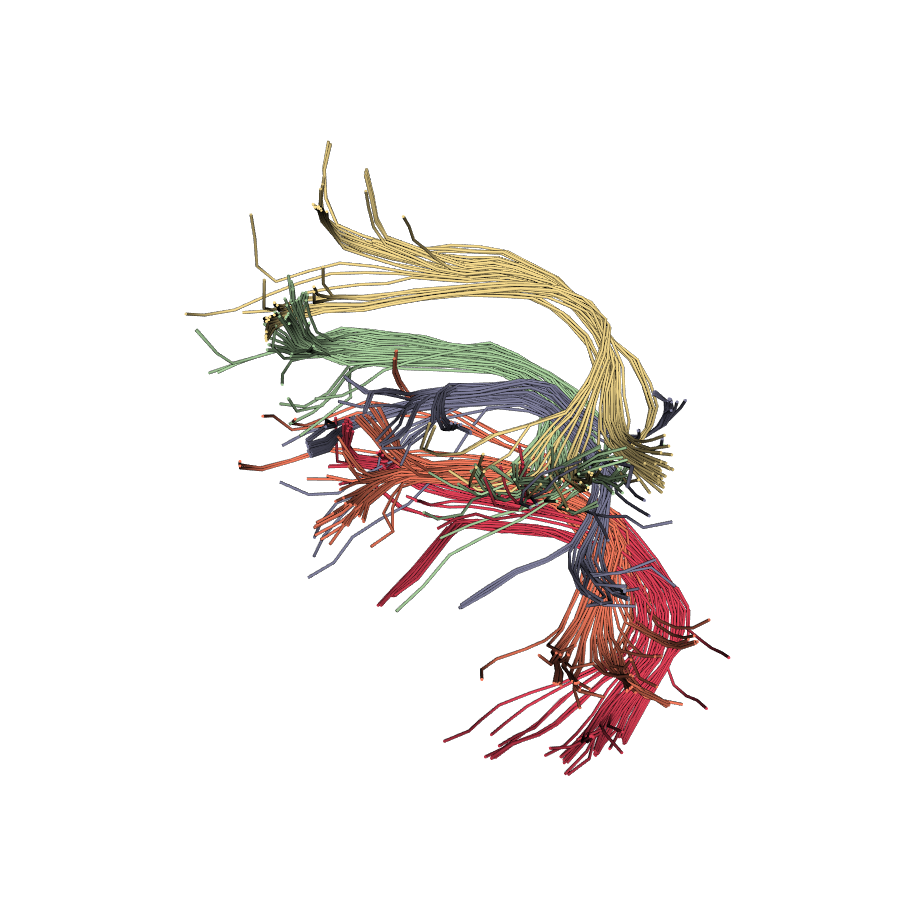
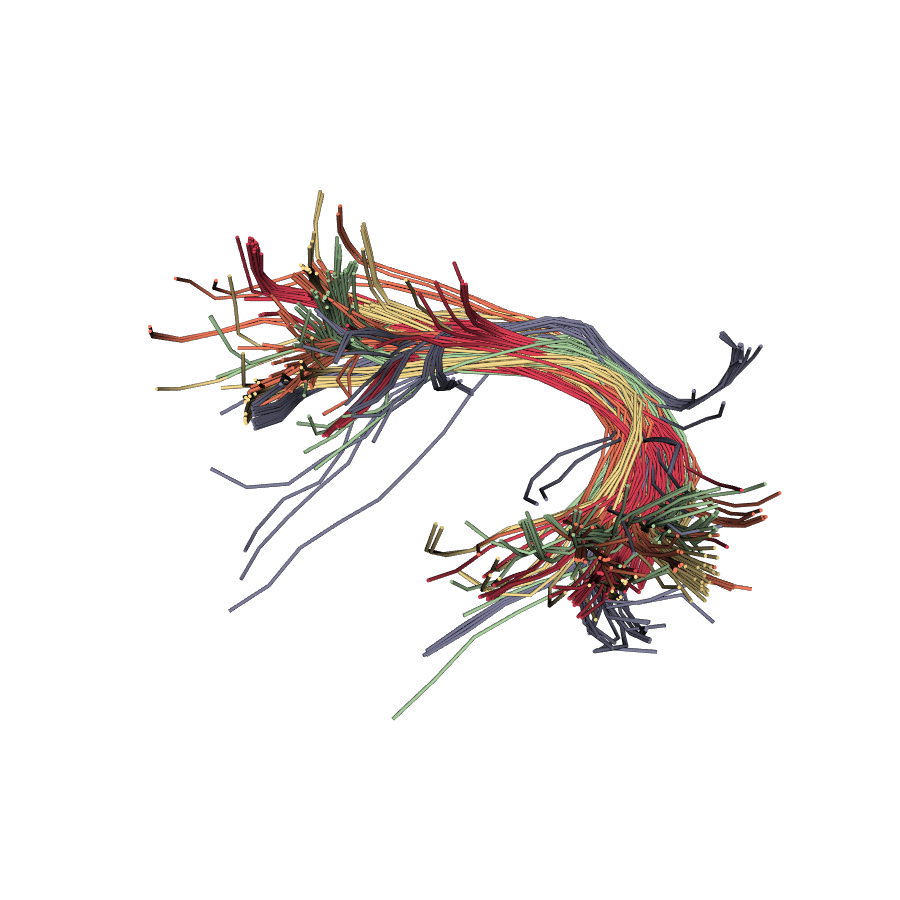
The left panel shows five bundles before alignment; they occupy different parts of space. After groupwise_slr, all five overlap in a common coordinate frame, making cross-subject comparisons meaningful.